Wednesday, March 20, 2013

The Rocketeer. Excellent Pulp Storytelling

This past weekend, the comic book website, comixology.com had a sale on Rocketeer comic books. So I figured "what the hell, I'll buy a few."When I was little I remember seeing the Rocketeer movie at the Ford City mall, and I really enjoyed it. So I bought a few issues. Now up to this point, I had never really read Rocketeer comics, so I was interested to see how much of the comic mythology was utilized in the film version.

I was very surprised and pleased to see that much of the Rocketeer movie utilized the storytelling methods and properties of the comic. The origin of the Rocketeer in the movie is pretty much the same as in the comics. The character's personalities are similar as well. And in the comics, the Rocketeer battles Nazis, just like in the movie. This made reading the comics to be very enjoyable and fun. It's nice to be able to read a comic and just be purely entertained. I think comics take themselves too seriously sometimes. Or are dark when they don't necessarily need to be dark. Reading the Rocketeer was fun. It's lighthearted, action packed, and refreshing.

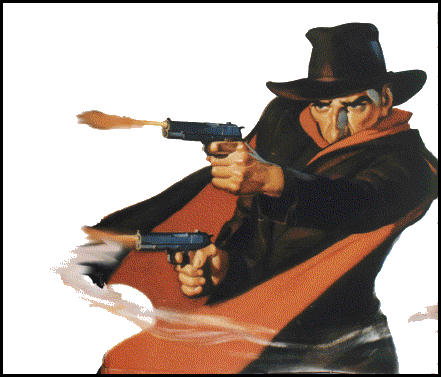
Created in the early 1980s by Dan Stevens, the Rocketeer is a love letter to the 1930s/1940s pulp dramas, film noira, and Saturday morning matinee serials. I love these genres and stories. The way stories are told in these genres of film are engaging, fast paced, and provide you the viewer with memorable characters. Examples of characters made famous in "serials" include: "Flash Gordon, The Green Hornet, and The Shadow".
Flash Gordon Serial
The Shadow from the old radio series


The Green Hornet Radio Show 


This genre of films would go on to inspire filmmaker George Lucas to create "Star Wars"and "Indiana Jones". These movies essentially are love letters to the old Saturday morning matinee serials. If you have never experienced this genre, I highly recommend it. In fact start with the Rocketeer. It's an excellent introduction.


P.S.: 
I would love to see a revival of the "matinee serial" story telling method. Especially in radio. I think the medium of radio and these pulp dramas would be a hand into a glove.

Sunday, March 10, 2013

Just Found this Post My Cousin Did on Inspiring Art

Spudart's Inspiring Art 

I literally just finished writing about art, and I found this blog post my cousin Matt wrote about inspiring art. It is a great read for anyone looking to explore the topic of art. I particularly like the images he used in the post. Especially the shadow puppet portrait. The link is above.


What is Art?

What is art? That question has been floating around in my brain for the last year or so. With the growth of social networking sites, the ease of sharing art with others is just a click of a button away. But there is a draw back. Just as easy it is for you to share "good" art, it is just as easy to share "bad" art too. But how are we able to tell the difference between the two. So this leads me back to my question, what is art? Or maybe more preciously what is good art?

Dictionary.com defines art as: "the quality, production, expression, or realm, according to aesthetic principles, of what is beautiful, appealing, or of more than ordinary significance." After pondering this question, logic suggests that what makes art good is then predicated on an individual's taste preference. If an individual can find beauty or appeal in the piece, then the piece has some form of artistic merit. But since artistic merit is then determined by individual taste, does that mean that a certain piece of art can be more "artistically good" than another piece of art based on the shear fact that more individuals like that piece than another?

Compare Da Vinci's Mona Lisa to Henry Darger's watercolors. Since the Mona Lisa is more well known than Darger's watercolors, is the Mona Lisa superior? I think some people would argue this point, that yes it is superior. But is that right? Again if we follow the definition of art, given to us by Dictionary.com, as long as the individual finds beauty or appeal in the piece, then it must "good" art. Hence the watercolors and the Mona Lisa are equals.

Not all pieces of art will have universal appeal to everyone. But isn't that the joy of art? That you can find beauty anywhere you look for it? By definition art should embrace diversity. The more I think about this question, the more I want to work on an audio documentary exploring art, and what makes art good.

Wednesday, February 27, 2013

Interviewing Yoko Ono

This past week, I did something I never thought I could of done in a million years. I interviewed Yoko Ono. Grant it, it was over email, so one of her assistants could of very easily done it for her. But it doesn't matter. I can formally say that I interviewed the widow of my hero, John Lennon.

Someone like Yoko seems so far away. Like she is from another universe. This person was a part of a moment that changed the world forever. That just blows my mind. Her, along with John, did things and wrote music that made this world a different place. And she answered MY QUESTIONS!!! It is almost like I climbed Mt. Olympus and was able to speak to Hera. 

It's a little difficult to wrap my brain around it. If I can interview her, then I could almost interview anyone. I tell my students that the worse anyone can tell you is no. If you can live with a no, then you have nothing to fear. An event like this, really reinforces that thought process for me. What's to say that I couldn't interview Sir Paul McCartney or Ringo Starr?

So I guess the lesson of this story is don't be afraid. You never know what you will be able to accomplish. I got to interview Yoko Ono.

Tuesday, February 19, 2013

PRX...Radio Gold

Over the weekend, I discovered a radio service called PRX. PRX is the Public Radio Exchange, and it essentially acts as a syndication service of radio programs and podcasts. Most of these programs are independently produced. (Check out their website, prx.org) Such programs that are "syndicated" from PRX include Sound Opinions, The Moth Radio Hour, and nowlikephotographs. If you have SiriusXM, you can listen to the PRX channel, it is #123. Additionally, many of PRX's programs air on NPR affiliated radio stations.

There are two things that I love about this. 1. I can submit my audio work for other people to listen to and enjoy. I have been looking for over a year for an avenue to promote my audio productions. Now it seems that I have found a viable outlet. 2. The variety. Over the past few days, I have listened to so many great radio programs and podcasts that my mind has literally been blown away. Anyone who says radio is not relevant anymore, has not heard any of the programs on PRX. It is great radio storytelling. I cannot say enough good things about it. Please try and check it out.

Wednesday, February 13, 2013

Unplugging from the Matrix


So I did an experiment this past weekend. I wanted to see if I could go the entire weekend without logging onto Facebook, Twitter, or Google+. I decided to conduct this experiment for a few reasons:

1. I felt for a while that I am becoming too dependent on social media and my phone to entertain me during my "down" periods. When I wake up in the morning, the first thing I do is grab my phone, check my emails and then log onto my various social networking sites. If I am waiting for someone or walking somewhere, what do I do, log into social networking. Even when I am watching TV, I find myself grabbing my iPad and see what else is happening, while I'm watching TV. I think my attention span has drastically decreased due to social networking and portable technology.

2. What am I looking at?! Over the weekend, most of my friends aren't even on social networking. It seems to be more of a "during the week activity". Yet I would still log on and re-read various old updates. What am I doing? And it wasn't like once in a while I would do this. It was like ever other hour. I was afraid that I would miss something if I didn't constantly check. Don't ask me why, because what happens on the news feed stays on the news feed, forever!!

3. I needed a break. I can't explain it. I just felt like I need to get away from others. Not that I was particularly angry with anyone. I just didn't want social networking to be my primary form of communication between myself and my network of friends. So if I wanted to talk to someone, I either called them or texted with them.

I am proud to announce that I was able to accomplish this goal, and much to my shock, rather easily. I stopped at 8pm on Friday evening and did not log in again until Sunday at 10pm. I found that I didn't miss Facebook or Twitter that much. And strangely enough, I found myself more engaged in the activities I was participating in. If I was watching a movie, I was more involved in the movie. If I was cooking, I just worried about cooking. It was a different experience not being glued to my phone or iPad constantly checking on my social networking accounts. Kind of reminded me of my youth.

So I think from now on, this is going to be the standard for me. On the weekends, I take a rest from the social networking sites. I would encourage you to do the same. I think you will appreciate things a little more when you are not constantly engaged in status updates, tweeting, or what have you.

Wednesday, February 6, 2013

What Will It Take to Make Radio Relevant Again/How I Would Fix Radio

I know another radio post...(Much of this, is stream of thought so be prepared)

For the past 15 years, I've been a sucker for the radio. It has introduced me to some of my favorite bands, provided me with some fantastic entertainment, and helped to develop my imagination. Yet commercial radio is in a terrible state. Online services such as Pandora, LastFM, and Spotify have taken a large chuck of the listening audience away from it. Radio stations continue to play the same songs by the same bands over and over and over again. And it always seems like they are going to commercial breaks. For all in tense and purposes radio has lost its excitement. You really don't have a reason to tune in on a regular basis.

This makes my job of running a college radio station extremely difficult. It is not easy trying to teach students the art of radio broadcasting when you cannot provide them with adequate examples of exciting radio. But then it dawned on me. I shouldn't be looking at radio's present for examples. I need to look to radio past. The golden age of radio was exciting, experimental, and a can't miss experience. Now I'm not just thinking of radio from the 1930s and 1940s, (although a lot of those old SciFi broadcasts such as X Minus One, Superman, or Sherlock Holmes are terrific), I'm also thinking of radio from about twenty years ago.

WXRT in Chicago is a prime example. XRT would play underground music on a regular basis. It was XRT that first introduced me to bands such as Wilco, Sufjan Stevens, and The Flaming Lips. Now a days it is rather hard to find XRT playing that unknown band about to break it big. In order for radio to survive, it needs to be fearless in the bands they play. Radio cannot be afraid to play music no one has heard of. They need to re-embrace this! Because even bands like the Beatles or Rolling Stones were unknowns at one point.

Secondly podcasts. Radio stations need to completely embrace podcasting. Why not view podcasting as radio on demand. Podcasting is a forum that allows you to be completely experimental. Because of this, there are some really great podcasts out there. My personal favorite podcast from the Canadian Broadcasting Company (CBC) and is called WireTap. Some other great podcasts include The Nerdist, The Art of Wrestling with Colt Cabana, and This American Life. One day I hope that someone could use podcasting as a way to create new radio theater play.

Ultimately I just hope that radio becomes exciting again. There is no reason why it can't be. Someone just has to be willingly to try something new and take that risk. Who knows, maybe that will be me. Actually I should use a few of the ideas I talked about and apply them to college radio. Hmmm.....